
A Social Experiment: Five Days on an Island Exploring Discomfort and Connection

I recently went to a Nonviolent Communication (NVC) Sharers gathering on Quarantine Island near Dunedin. The setting itself already felt like a social experiment: five days on an island, arriving and leaving only by pre‑booked water taxi. Apart from the island warden, there was no one else there.

I went without really knowing anyone. I had met some people online before, but we hadn’t spent much time together, and there were others I had never seen at all. Knowing that everyone there was familiar with empathy, conscious communication, and deep listening, you might expect it to feel safe and comfortable from the start.
For me, it wasn’t.
Growing up as a people pleaser, big groups still make me nervous. I don’t quite know how to behave. There’s a fear of not fitting in, paired with a strong wish to stay true to myself - and a quiet hope that I’ll be accepted for who I am. Intellectually, my head knew there was nothing to be afraid of. My body, however, told a different story. Inside, I felt tense, unsure, and vulnerable - even while parts of me were also feeling appreciated, supported, and gently encouraged by the others on the island. These seemingly contradictory experiences existed side by side.
Stress showed up in very physical ways, though not in the ways we often expect. My heart rate wasn’t racing and I wasn’t visibly unsettled. Instead, the stress showed up more quietly: in my digestion slowing down and in my period stopping - a clear signal that my system was in survival mode.

It took time. I gave myself space, spent time alone, and stuck to my morning yoga routine. I became more of an observer. And that’s when I noticed something uncomfortable but honest: when someone talked to me, I was so focused on my own words - and on how they might be received - that I barely had the capacity to truly listen. At the same time, I found myself talking more than usual, as if I were unconsciously searching for reassurance: You’re okay. You belong here.
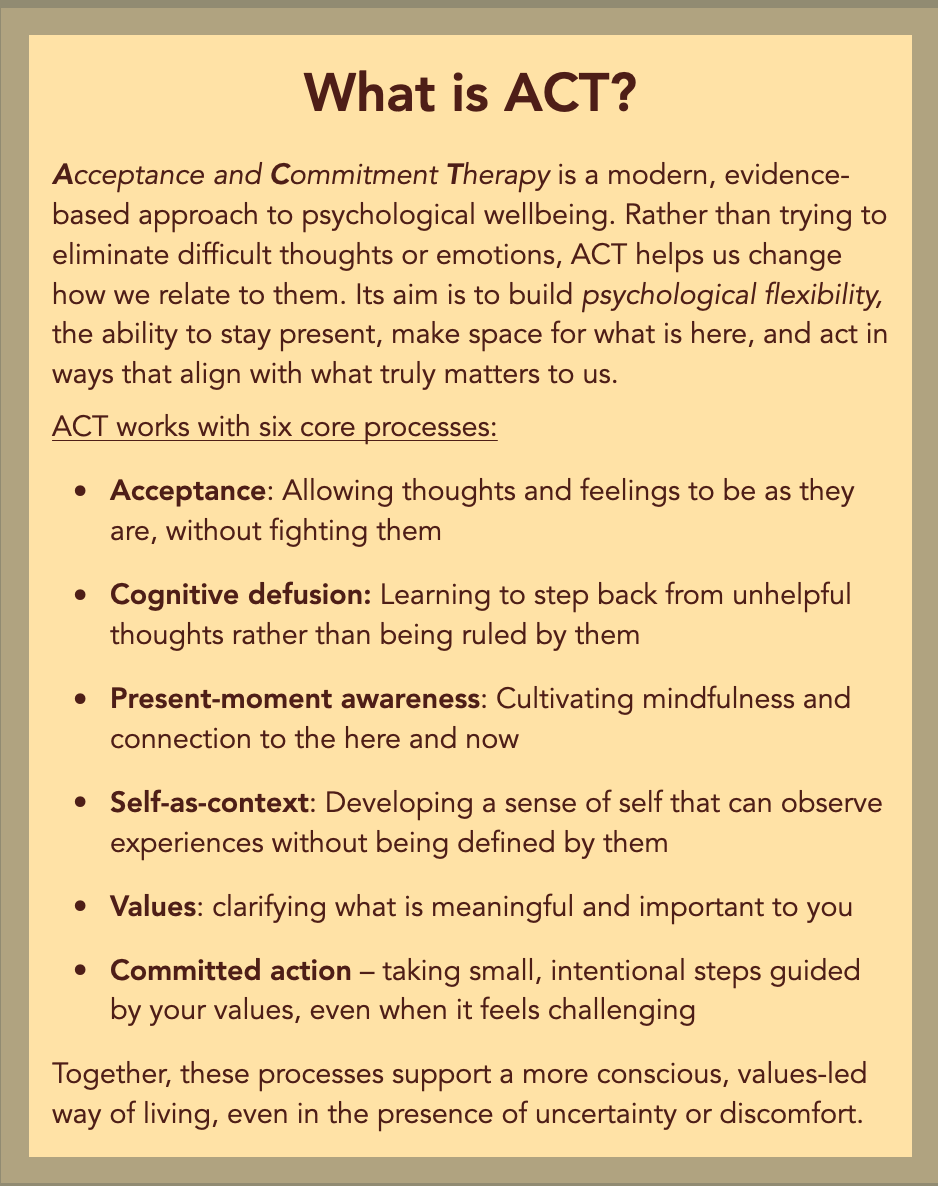
From an Acceptance and Commitment Therapy (ACT) perspective, this was a moment of awareness. I could see the uncomfortable feelings and I could notice the urge that came with them: to please, to adapt, to present myself differently in order to feel safe.
The practice, though, wasn’t to make those feelings disappear but to allow the discomfort to be there without letting it run the show. Instead of acting on the impulse to perform or please, I chose to come back to what matters to me: authenticity, sustainability, and growth alongside honesty, self-connection, and respect for my own limits.
One thing that made it easier and more comfortable was talking about it. Being in a group of other NVC sharers created a safe environment to describe what was happening inside of me. Naming my inner experience, instead of hiding it, actually created more connection rather than less.
Allowing myself to be seen in my vulnerability and hearing the others react on it with warmth, support and understanding helped my nervous system settle in ways I couldn’t have achieved on my own.
Day by day, things softened. My nervous system slowly settled. Towards the end of the week, I felt genuinely comfortable in the group. I felt proud, not because I had finally relaxed, but because I had stayed true to myself and was still accepted.
I didn’t force connection. I listened to my body and retreated when I needed to. I stood up for my values - authenticity, sustainability, and growth - and I learned a lot about myself.
One of the deepest learnings was this: feelings like not being enough or not belonging are still engraved in my body, even though my life has offered me many experiences that prove otherwise. Healing isn’t just about collecting positive evidence. It’s also about learning to notice uncomfortable inner experiences, make space for them, and choose actions that are aligned with our values - again and again.
This experience reminded me that true connection doesn’t come from being liked. It grows when we allow ourselves to be present with what is - including the discomfort - and choose to show up as ourselves.
What about you?
Where in your life do you notice discomfort showing up?
What urge follows that discomfort (for example: pleasing, withdrawing, performing)?
If you paused for a moment, what value would you want to let guide your next step instead?
I am curious to hear from your experiences,
Ronja


Comments